Situation
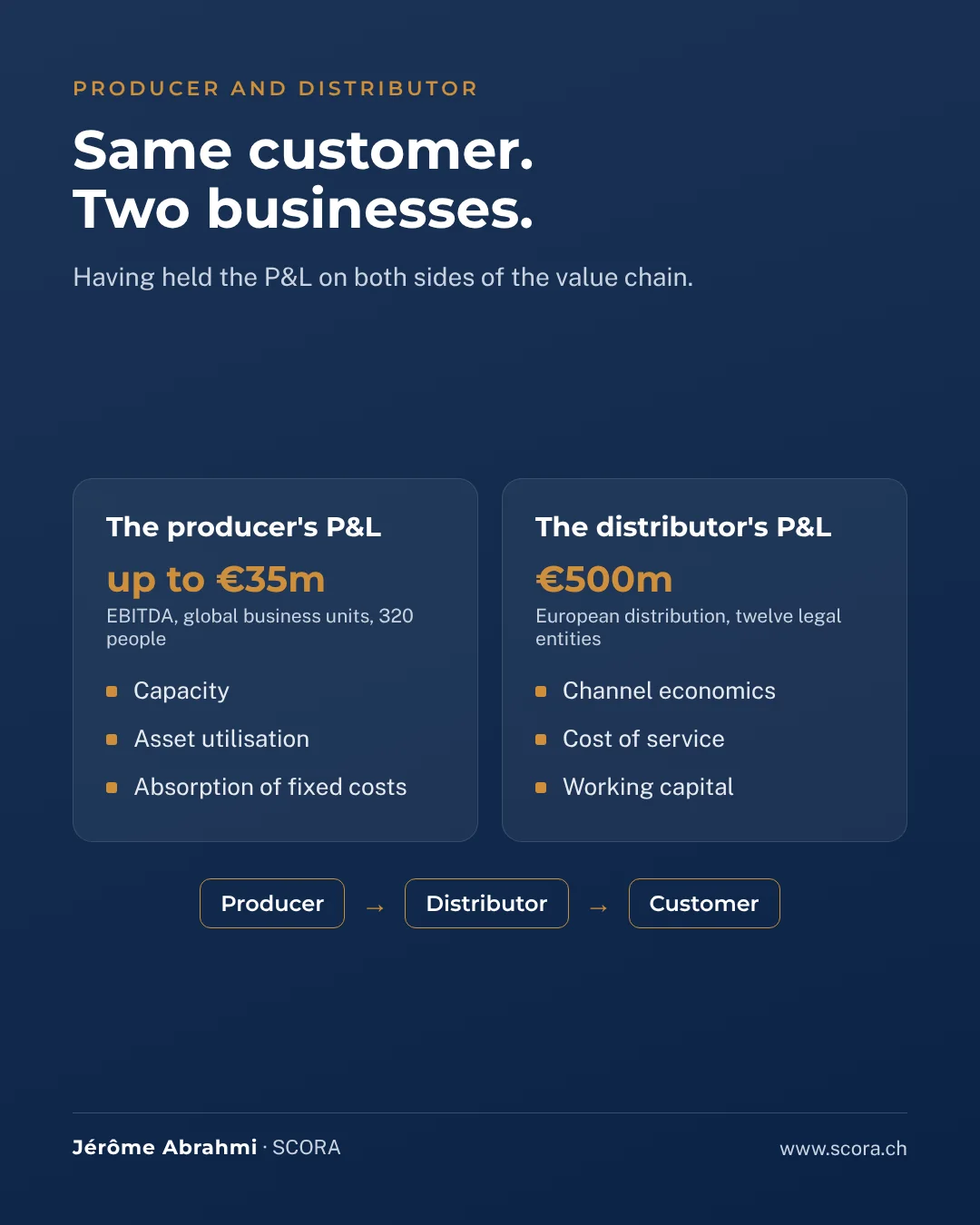
A producer and a distributor can serve the same customer and see two different businesses. Each reads that customer through its own economics. As long as these two readings remain implicit, discussions between them concentrate on price, whereas most of the margin is decided elsewhere.
The producer's view
The producer reasons in terms of capacity, asset utilisation and the absorption of fixed costs. A customer matters for the volume it brings to a line, for the regularity of its orders and for its place in the production plan. A small order for a specific grade can cost more than it earns if it requires a product changeover on a line that is already fully loaded.
The distributor's view
The distributor reasons in terms of channel economics, cost of service and working capital. A customer matters for the margin it leaves once order handling, delivery, storage and the credit granted have been deducted. Each day of stock and each day of credit weighs on profitability.
Where the value lies
Neither view is wrong. A negotiation between the two parties is nevertheless more productive when each understands how the other earns its margin. Three situations illustrate this.
The first is a channel review. Deciding which customers to serve directly and which to entrust to a distributor requires a comparison, customer by customer, of the contribution to the plant and the cost of service.
The second is a distribution agreement. Volumes, stock levels, payment terms and the pricing mechanism determine the margin of both parties. An agreement built on one view alone shifts the burden to the other party without creating value.
The third is a carve-out. When a business is separated from its group, the allocation of customers between direct sales and distribution, and the agreements that govern it, should be examined during due diligence, since they determine the margin of the separated business from the first day.
In each of these situations, some information helps the discussion. The producer benefits from knowing the distributor's cost of service and stock level for each customer. The distributor benefits from knowing which volumes matter for the lines, the batch sizes and the production lead times.
Conclusion
Between a producer and a distributor, margin is not shared through price alone. It depends on line utilisation at the former, and on cost of service and working capital at the latter. A channel review, a distribution agreement or a carve-out based on both views can create value for both parties, whereas an approach based on one view alone merely shifts it from one to the other.