State of play at 18 October 2026
Regulation (EU) 2023/851 requires a 100% reduction in CO2 emissions from new cars and vans from 2035. It remains the applicable rule until a new text is adopted.
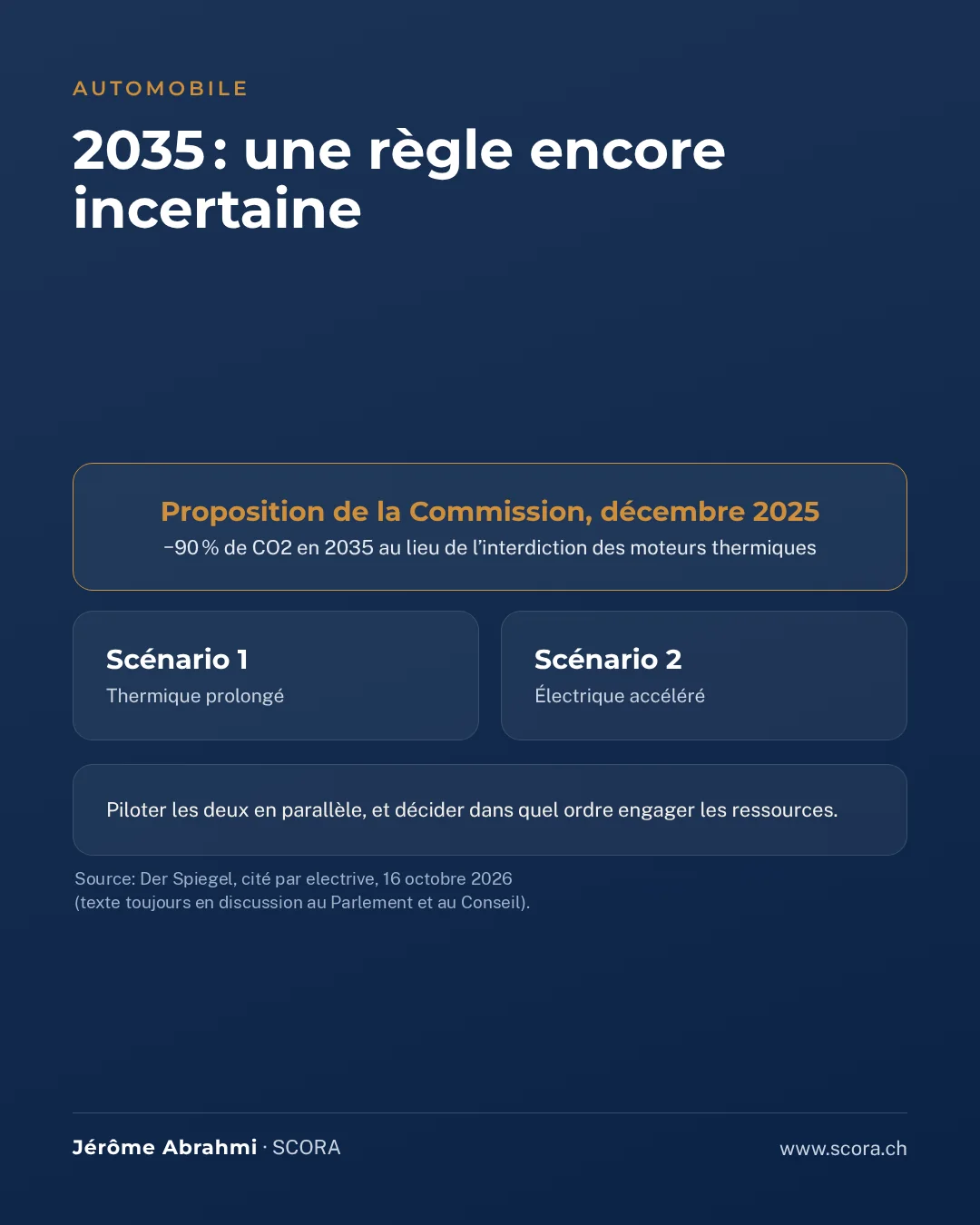
On 16 December 2025, the European Commission proposed lowering this target to 90%, with the remaining 10% offset by low-carbon steel produced in the Union, synthetic fuels or biofuels. Plug-in hybrids, range extenders, mild hybrids and combustion engines would therefore retain a place after 2035. The proposal also provides super-credits for small electric cars manufactured in the Union and relaxes the 2030 deadline through a mechanism for banking and borrowing credits over the period 2030 to 2032.
In the European Parliament, the rapporteur, Massimiliano Salini, tabled his draft report on 17 April 2026. Several amendments would go further than the Commission's concessions, and the debate focuses mainly on combustion cars running on synthetic fuels. The Parliament's procedure file schedules a plenary vote for 23 November 2026.
The Council has not yet adopted a position. At the end of September, member states remained divided, with Germany seeking the greatest flexibility. On 16 October 2026, according to Der Spiegel as reported by electrive, France and Germany agreed on a basis for negotiation: a 90% reduction, with no obligation to offset the remaining 10%, in return for stricter "Made in Europe" rules. The details remain to be negotiated. The Commission has also undertaken to review these rules, which could reopen the file after an agreement.
Consequences for materials suppliers
Qualifying a material with a carmaker or a first-tier supplier is a lengthy process. Testing and integration into a vehicle programme commit the supplier well before series production. Decisions taken today therefore concern vehicles that will be sold under a rule that is not yet known.
Three courses of action are possible. The first is to wait for the text to be adopted, which gives competitors time to qualify their products. The other two are to anticipate one of the two scenarios, extended use of combustion engines or accelerated electrification, which commits capacity and teams to an assumption the legislator may still change.
The most prudent approach is to manage both scenarios in parallel. This first requires classifying the automotive portfolio by its exposure to each scenario, product by product and customer by customer. It then requires giving priority to qualifications that are useful in both cases and limiting those that serve only one. The milestones that will trigger a reallocation of resources should also be set in advance: the plenary vote, the Council position and the Commission's review. Finally, the order in which capacity, technical teams and investment will be committed has to be decided.
Conclusion
Until the Parliament and the Council adopt a text, the 2035 rule remains uncertain, and a subsequent review could still change it. For a materials supplier, the priority is to build a portfolio and a qualification plan that remain viable under both scenarios, and to set decision milestones now, rather than to speculate on the outcome of the debate.
Sources
- European Commission, "Cars and vans" page, updated 30 January 2026 (Regulation (EU) 2023/851; December 2025 proposal).
- European Parliament, Legislative Train, procedure 2025/0420(COD), updated 20 June 2026.
- EU Insider, 28 September 2026.
- electrive, 16 October 2026, citing Der Spiegel.