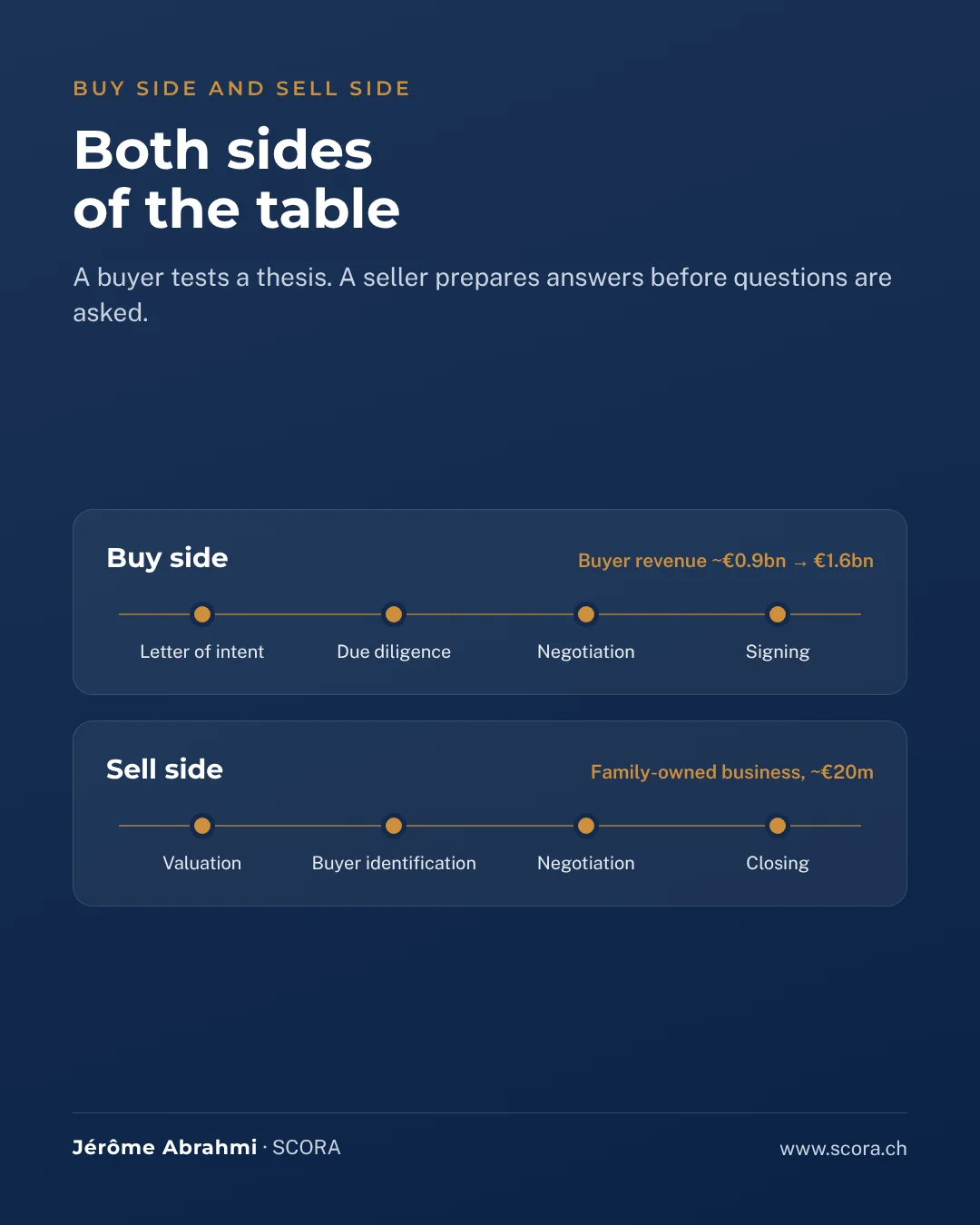
The buyer's thesis and due diligence
An industrial or financial buyer acquires a thesis: an account of how the company will create value once it joins the buyer's portfolio. That thesis rests on strategic coherence (markets, competitive positions, fit with existing businesses), industrial coherence (sites, capacity, condition of the assets, investment required) and commercial coherence (customers, contracts, margins by application and by segment). The buyer builds its own valuation on that thesis, and due diligence serves to confirm or correct it.
Financial due diligence establishes the quality of earnings and net debt. Commercial and industrial due diligence completes that reading: it checks that volumes and margins hold application by application, that the sites can carry the plan without unforeseen investment and that the main customers will stay. From letter of intent to signing, each finding feeds into the negotiation as a price adjustment, a warranty and indemnity, or a condition precedent.
What the seller must establish before the sale
The seller has one advantage: it knows the company better than any acquirer. That advantage counts only if it is documented before the process opens. The first step is valuation, which rests on two approaches. The earnings approach applies a multiple to EBITDA, or discounts the cash flows of a credible business plan. The asset approach revalues the assets at market value: land, buildings, production and storage facilities. For an asset-rich business, such as an agricultural trading company with silos and a sorting station, the earnings approach can understate the asset base. The gap between the two approaches then becomes a central point of the negotiation, and the seller must be able to substantiate it with a land valuation and a precise account of the condition of its facilities.
The second step is the data set: restated accounts, business plan, main contracts, and the status of assets, permits and staff. A complete file shortens due diligence and limits last-minute adjustments. The third step is to identify plausible acquirers, industrial or financial, for whom the company fits a thesis. Finally, the seller anticipates the questions each of them will ask and prepares quantified answers.
Valuation, price and the decisive questions
Valuation is an estimate of value, and each party arrives at its own. Price is the outcome of the negotiation and is set in the sale and purchase agreement: it starts from enterprise value, deducts net debt, is adjusted for working capital and comes with the agreed warranties and, in some cases, an earn-out. Between the two, the negotiation turns on the assumptions.
Some questions change the price: the quality and recurrence of earnings, margins by application, the value and condition of the assets, and the investment required after completion. Others decide whether the transaction takes place at all: the company's fit with the buyer's thesis, and its dependence on a few customers, a supplier or the owner-manager. A party that has held both positions identifies these questions earlier and deals with them before they become breaking points.
Preparation from both sides
A transaction turns on a limited number of questions, which an experienced party knows from the outset. On the buy side, they determine what due diligence must establish; on the sell side, they determine what the valuation and the data set must demonstrate before the process opens. Knowledge of both positions makes it possible to prepare a transaction around the questions that set the price and those that bring it to completion.
Sources
- DOMO Chemicals: announcement of the acquisition, August 2019.