State of the market at 20 October 2026
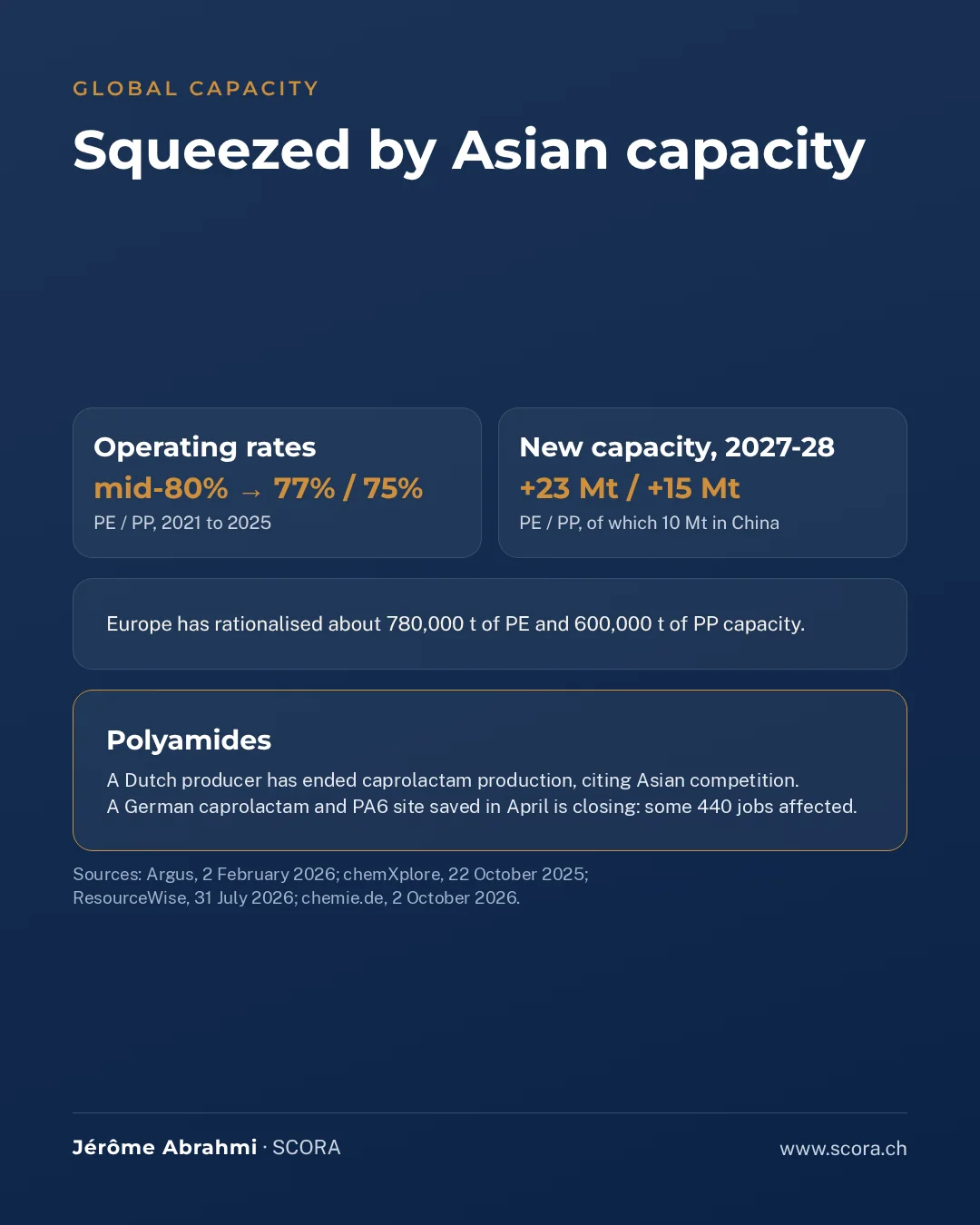
According to Argus, writing in February 2026, the global polyolefins market is firmly oversupplied. Global operating rates, in the mid-80s per cent range in 2021, fell in 2025 to 77% for polyethylene and 75% for polypropylene. A second wave of new capacity, 23 million tonnes of polyethylene and 15 million tonnes of polypropylene, is expected in 2027 and 2028, of which 10 million tonnes in China for the two polymers combined. Argus expects operating rates to bottom out at 74% as a result. In Europe, around 780,000 tonnes of polyethylene capacity and 600,000 tonnes of polypropylene capacity were rationalised over the preceding two years.
Polyamides are on the same course. In the Netherlands, Fibrant announced in October 2025 that it would end caprolactam production at Chemelot, with the loss of around 100 jobs, citing high production costs and competition from lower-cost Asian producers. ResourceWise confirmed the closure in July 2026. According to the same source, Europe structurally imports around 12,000 tonnes of polyamide 6 resin a month from China.
Consequences for European polymer businesses
Global overcapacity on this scale does not affect every business in the same way. For standard grades, sold to specification and shipped by container, the European price tends to align with the delivered price of imports. Margin then depends on the cost of energy and feedstock, over which a European producer has little control. The rationalisation already under way in Europe shows that these positions are becoming difficult to hold.
Other positions are more resilient, because imports cannot replicate them: grades formulated for a specific application, qualified with the customer and difficult to replace; volumes that require local service, short lead times, small batches or technical support; and markets where regulation, traceability or compliance restrict access to unqualified products.
The decisive issue is therefore where, product by product and customer by customer, a European business retains a margin that imports cannot take. Addressing it first requires separating, within the portfolio, the volumes exposed to import prices from those protected by qualification, service or regulation. It then requires allocating capacity, technical and commercial teams and investment to the latter. Finally, it leads to decisions on which of the former to discontinue, combine or sell, before the second wave of capacity reduces margins further.
Conclusion
According to Argus, operating rates have not yet reached their low point, which is expected with the second wave of capacity in 2027 and 2028. For a European polymer business, the priority is not to defend the whole portfolio. It is to identify the products whose margin rests on qualification, service or regulation, to concentrate resources on them, and to decide on the others before margins narrow further.
Sources
- Argus, 2 February 2026: global polyolefins market, operating rates, new capacity in 2027 and 2028, rationalisation in Europe.
- chemXplore, 22 October 2025: end of Fibrant's caprolactam production at Chemelot.
- ResourceWise, 31 July 2026: European polyamide and caprolactam markets (Fibrant closure, polyamide 6 resin imports from China).