State of the sector at 20 October 2026
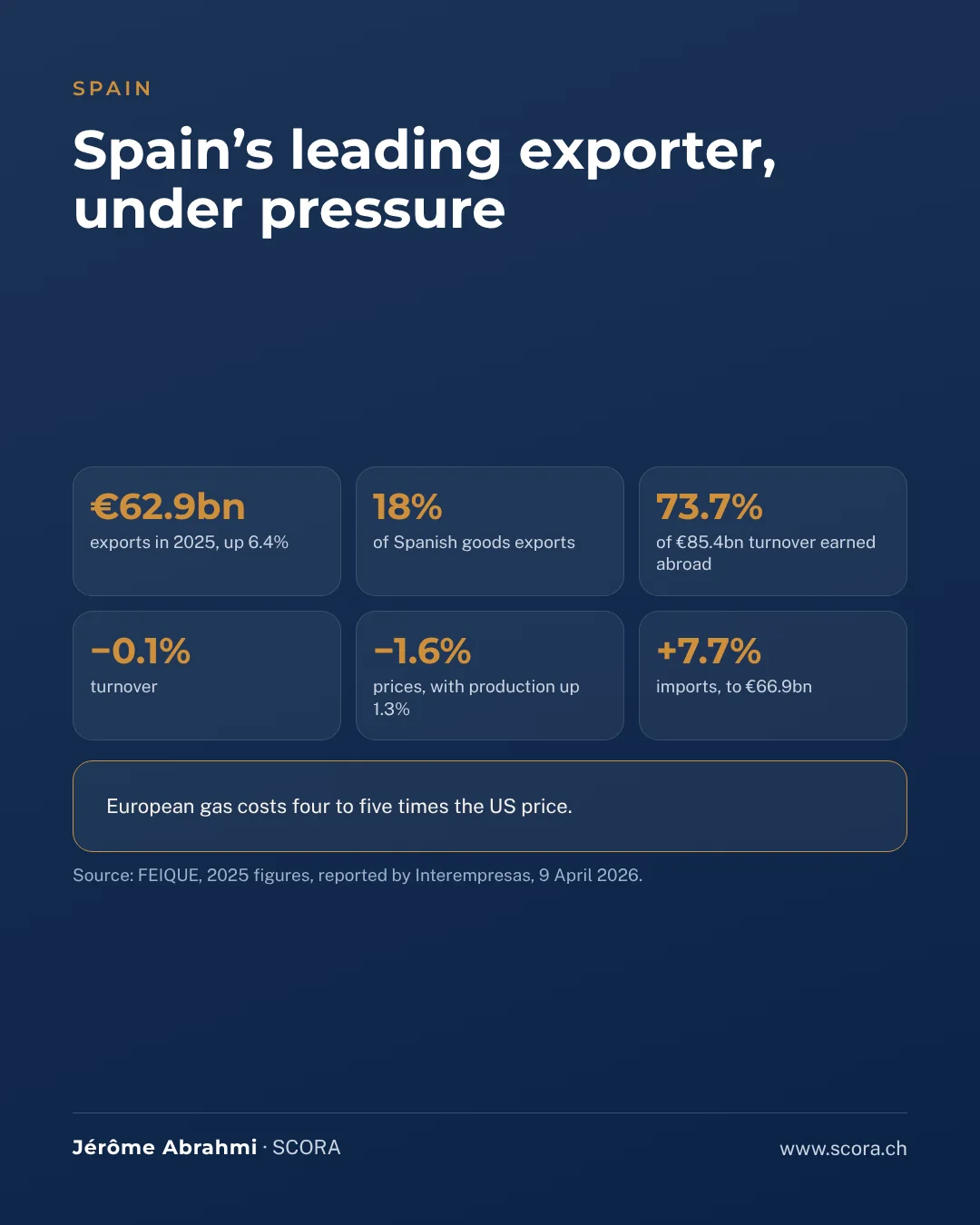
According to FEIQUE, the Spanish chemical industry federation, the sector's turnover reached €85,417m in 2025, down 0.1%. Production rose by 1.3%, but prices fell by 1.6%.
Exports reached €62,926m, up 6.4%. They account for 18% of Spain's goods exports, ahead of the automotive industry (16.1%) and the agri-food industry (15.2%). The sector earns 73.7% of its turnover abroad, and 56% of its exports go to the European Union.
Imports grew faster, by 7.7%, to €66,852m. They come mainly from the United States (12.7%) and Germany (12.6%).
Energy weighs on competitiveness. Gas is four to five times cheaper in the United States than in Europe. In the first half of 2025, industrial electricity cost an average of €179/MWh in the European Union, compared with €80 to €110/MWh in the United States and China. Between 2019 and the end of 2025, the average price of gas rose by 145% and that of emission allowances by 170%.
Consequences for executives and investors
A Spanish chemical or plastics company is rarely a domestic business. With almost three quarters of the sector's turnover earned outside Spain, its value depends first on its export markets, on the strength of its channels and on its ability to serve European customers at a distance.
It depends next on its exposure to energy. Higher costs for gas, electricity and emission allowances reduce the margin of the most energy-intensive activities, and falling selling prices do not allow this to be offset.
It depends finally on its ability to defend margins against imports. When imports grow faster than exports and prices fall, competition takes place in the domestic market as much as in export markets.
For an acquirer or a shareholder, assessing such a company therefore requires reading, for each product line, the share exported and the countries of destination, the energy intensity and the mechanism for passing on costs, as well as the position against imported products. These factors determine value more than the volume sold.
Conclusion
Spain's leading exporter remains solid in volume terms, but its prices are falling, its imports are growing faster than its exports and its energy cost gap with the United States persists. For a Spanish chemical company, value lies in the quality of its export markets, in the control of its energy exposure and in its ability to defend margins, product by product, against imports.
Sources
- FEIQUE, 9 April 2026: 2025 results of the Spanish chemical industry (turnover, production, prices, foreign trade, energy costs).