Falling volumes and idle capacity in European chemicals
For a producer, every tonne lost reduces the absorption of fixed costs, which creates pressure to favour volume. Discounting is then the quickest lever to pull. Discounts are negotiated customer by customer, under pressure from a buyer or a competitor, and their effect on margin only appears at the end of the period. Granted repeatedly across a portfolio, they bring prices into line with those of the most aggressive competitors, including in applications where the product delivers value well above its price. When competitors also have idle capacity and respond in kind, little volume is regained and margin declines.
What determines pricing power
A company has pricing power when it obtains from its customers a price that reflects the value the product brings them, without losing a significant share of its volumes. For a given product, this capacity varies with the application. In some uses, an additive accounts for a tiny share of the cost of the finished article while determining its service life, its compliance with standards or its manufacturing yield; the customer is buying performance, and the price can reflect the value created. In others, the same additive can be replaced by a competitor's without consequence for the customer, who decides on price per kilogram, and the market price then prevails.
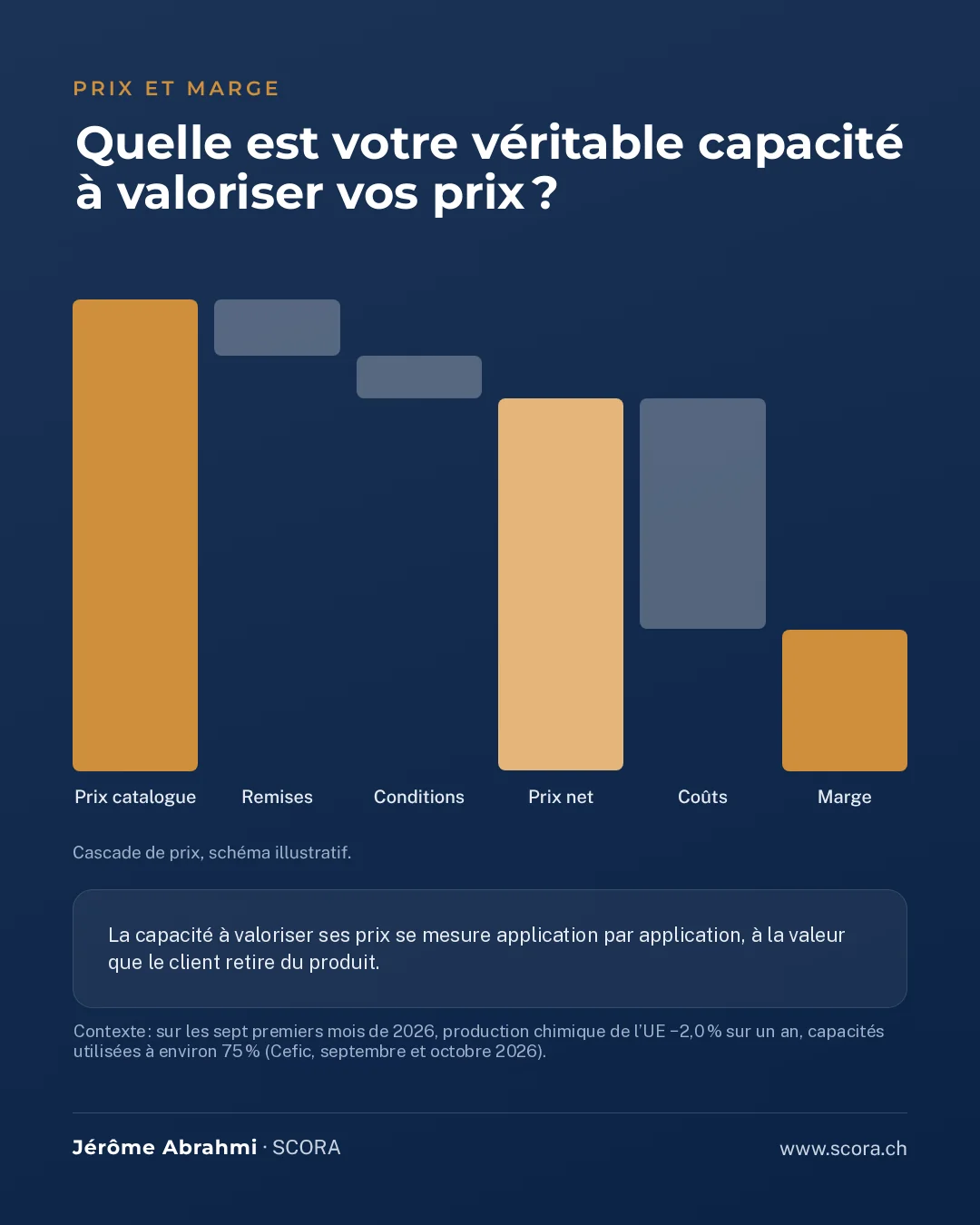
Measurement of this capacity rests on three criteria. The first is value to the customer, calculated on total cost of ownership, which takes into account product efficiency, dosage and the cost of each raw material rather than price per kilogram alone. The second is competitive position in the application, which depends on whether a substitute is already qualified and on the time and cost of a new qualification at the customer. The third is net profitability by customer, product and segment, after discounts, commercial terms and logistics and service costs, as shown by the price waterfall. Combining these criteria makes it possible to rank the applications in a portfolio and to identify those in which price can be raised without significant risk to volume.
From measurement to value proposition
The value proposition is built on these three criteria. For each application and each market segment, it sets out what the product brings to the user, quantified as total cost of ownership, its position against competing products already qualified, and the price level that this value can support. It translates into target and floor prices by application, rules for granting discounts and, in production, an allocation of lines consistent with the chosen segmentation. The sales force then has quantified arguments based on the value of the product to the customer.
A measurement based on the company's own data
When volumes are falling, price established application by application becomes a direct lever on margin. Measuring pricing power requires the company's internal data, whether sales by customer and application, the price waterfall, service costs or available capacity. The executive workshop offered by SCORA addresses this question in one day with the executive committee, on the company's own figures. It produces a first pricing model and can serve as the scoping stage for an assignment.
Sources
- Cefic: Chemical Trends Report Q3 2026, October 2026.
- Cefic: Chemical Trends Report Q2 2026, September 2026.