State of the market at 18 October 2026
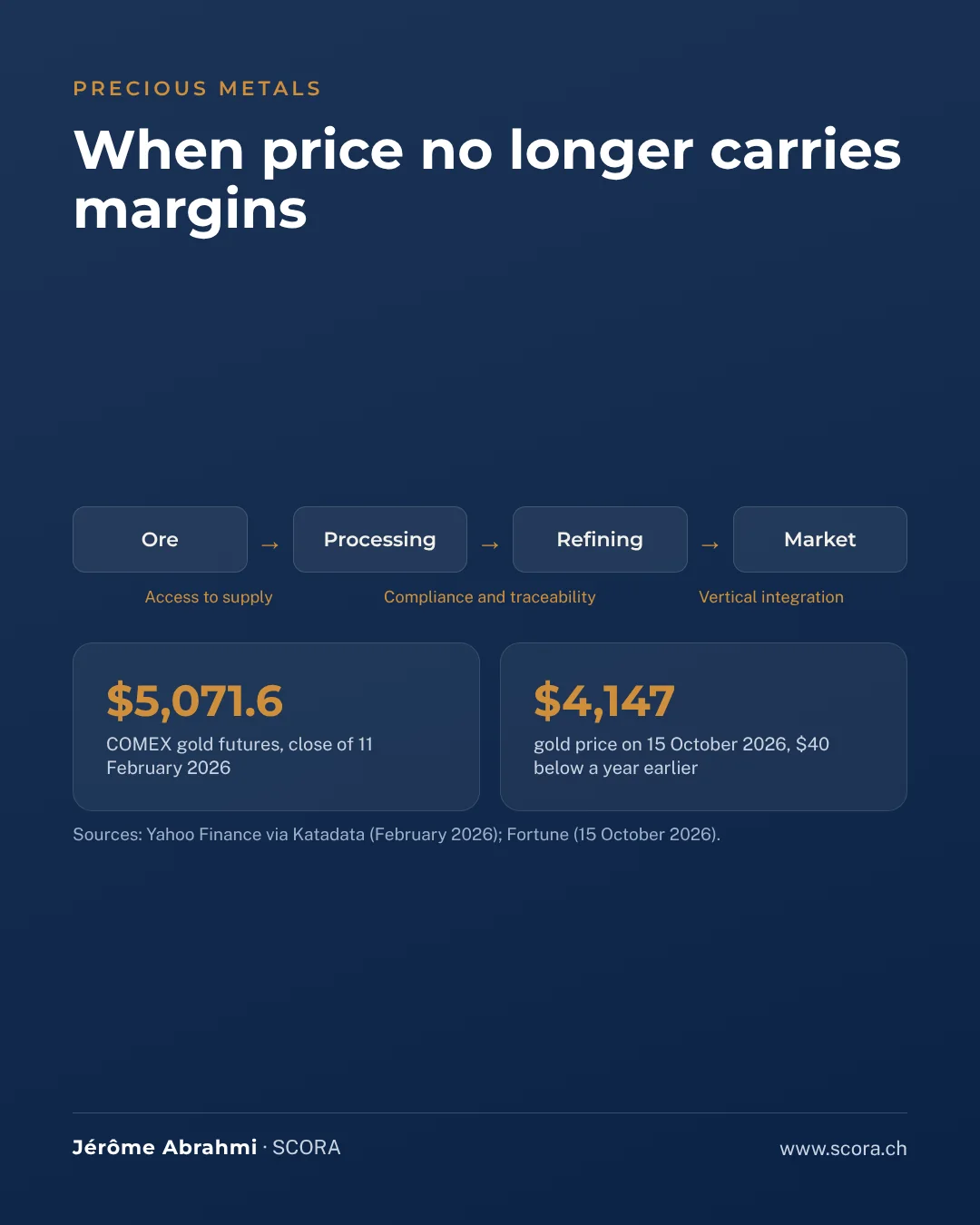
On 11 February 2026, COMEX gold futures closed at $5,071.6 an ounce. On 15 October, gold stood at $4,147 an ounce, compared with $4,291 a month earlier and $4,187 a year earlier. The mid-October level is therefore slightly below that of October 2025. The two references do not relate to the same instrument, a futures contract in one case and the price reported by Fortune in the other; they nevertheless indicate the order of magnitude of the movement.
Consequences for the value chain
In a processing business that buys the ore it treats, the margin depends on the difference between the price paid for the ore, the processing costs and the value of the gold recovered. While the gold price rises, this difference holds almost automatically and volume is sufficient to increase earnings. When the price falls, processing costs do not fall with it, the margin narrows and volume is no longer sufficient.
Value then moves towards two elements. The first is access to ore: the ability to secure regular volumes, in quantity and in quality, determines the utilisation rate of the plants. The second is the compliance of the supply chain: gold whose legal origin and traceability are established finds outlets more easily, and LBMA standards serve as the market's reference.
Three strategic levers follow. The first is upstream vertical integration, which secures supply and protects plant utilisation. The second is external growth, which makes it possible to acquire processing capacity or sources of supply faster than through internal development. The third is investment in compliance and traceability, which determines access to the most demanding outlets. These levers are prepared during periods of high prices, when the company has the means to finance them; they take effect when the price falls.
The way an investor or an acquirer assesses a processing asset also changes with the cycle. When prices are high, the volume processed and current earnings dominate the valuation. When the price falls, the reliability of supply sources, the regularity of volumes and the state of compliance carry more weight, because they determine the margin of the following years.
Conclusion
A price cycle changes both the level of margins and where they are formed. For a gold processing business, lasting value lies in access to ore and in the compliance of the supply chain. Both are built during periods of high prices and protect the margin when the price falls.
Sources
- Yahoo Finance, via Katadata: COMEX futures, close of 11 February 2026.
- Fortune, 15 October 2026: gold price per ounce.