State of the sector at 18 October 2026
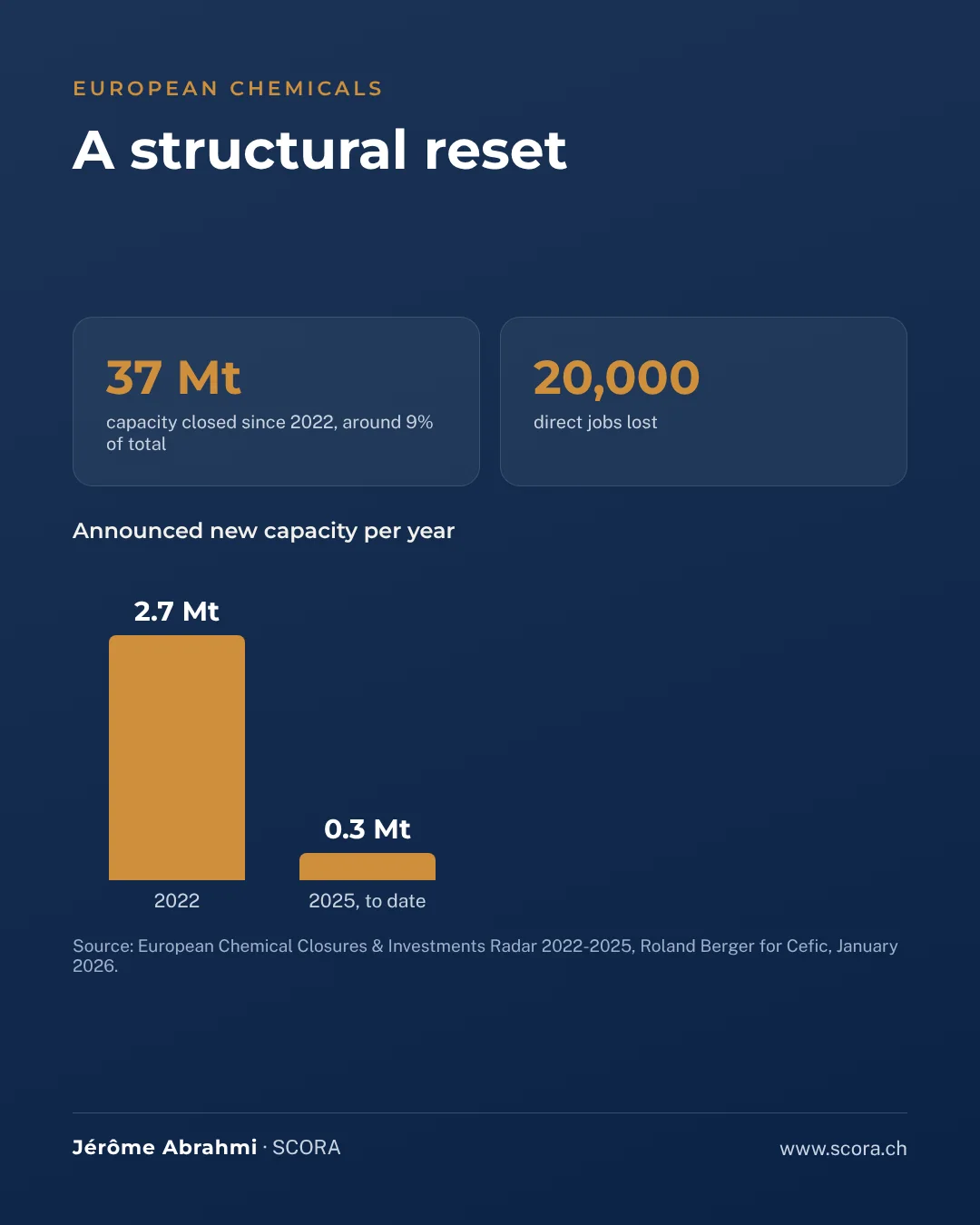
According to a report by Roland Berger for Cefic, published on 28 January 2026, 37 million tonnes of capacity have been closed in Europe since 2022, around 9% of the total. Over the same period, announced new capacity fell from 2.7 million tonnes in 2022 to 0.3 million tonnes in 2025, at the report's data cut-off. The report puts the number of direct jobs lost at 20,000 and the number of indirect jobs at risk at around 89,000.
In a report published in April 2026, FTI Consulting describes a structural reset that goes beyond the sector's usual cycle and reflects energy costs, global overcapacity and the relative competitiveness of regions. Commodities and energy-intensive segments face lasting pressure on margins and are consolidating. Specialties are more resilient, while remaining exposed to margin pressure downstream.
In petrochemicals, ChemOrbis counted at 7 October 2026 close to 11 million tonnes a year of olefins, polyolefins and vinyls capacity closed, idled or scheduled for closure since 2024. More than 10 million tonnes a year have changed or are due to change ownership. LyondellBasell's European portfolio and SABIC's European petrochemicals business have been sold, or are being sold, to AEQUITA, and Vynova's Wilhelmshaven site has been acquired by Westlake.
Consequences for executives and shareholders
The closure of base capacity does not remove value from the European chemical industry. It moves it in three directions.
The first is towards specialties, where margin depends more on the value proposition, applications and service than on the cost of energy. The second is towards reconfigured industrial footprints, with fewer sites, reassigned lines and redesigned supply chains. The third is towards assets that change hands, through portfolio disposals, carve-outs or site acquisitions.
Each of these situations raises operational questions as much as financial ones. An acquirer has to assess a site's ability to operate on its own, its actual costs, its customers and its supply contracts. A seller has to prepare a business that can be separated and clearly understood. A group that retains its assets has to decide which to specialise, which to combine and which to shut down. These decisions require a precise understanding of plants, margins and customers, beyond financial analysis.
Conclusion
Closures and changes of ownership are continuing: in petrochemicals, ChemOrbis reports further shutdowns scheduled until 2027 and several groups of assets whose future is still under review. For executives and shareholders, the task is now to identify the assets that will be worth more in other hands or under a different organisation, and to prepare these transactions with an industrial as well as a financial reading.
Sources
- Cefic, 28 January 2026: Roland Berger report, European Chemical Closures & Investments Radar 2022-2025.
- FTI Consulting, 13 April 2026: European Chemical Industry, From Structural Stress to Strategic Reset.
- ChemOrbis, 7 October 2026: state of closures and disposals in European petrochemicals.