State of play at 18 October 2026
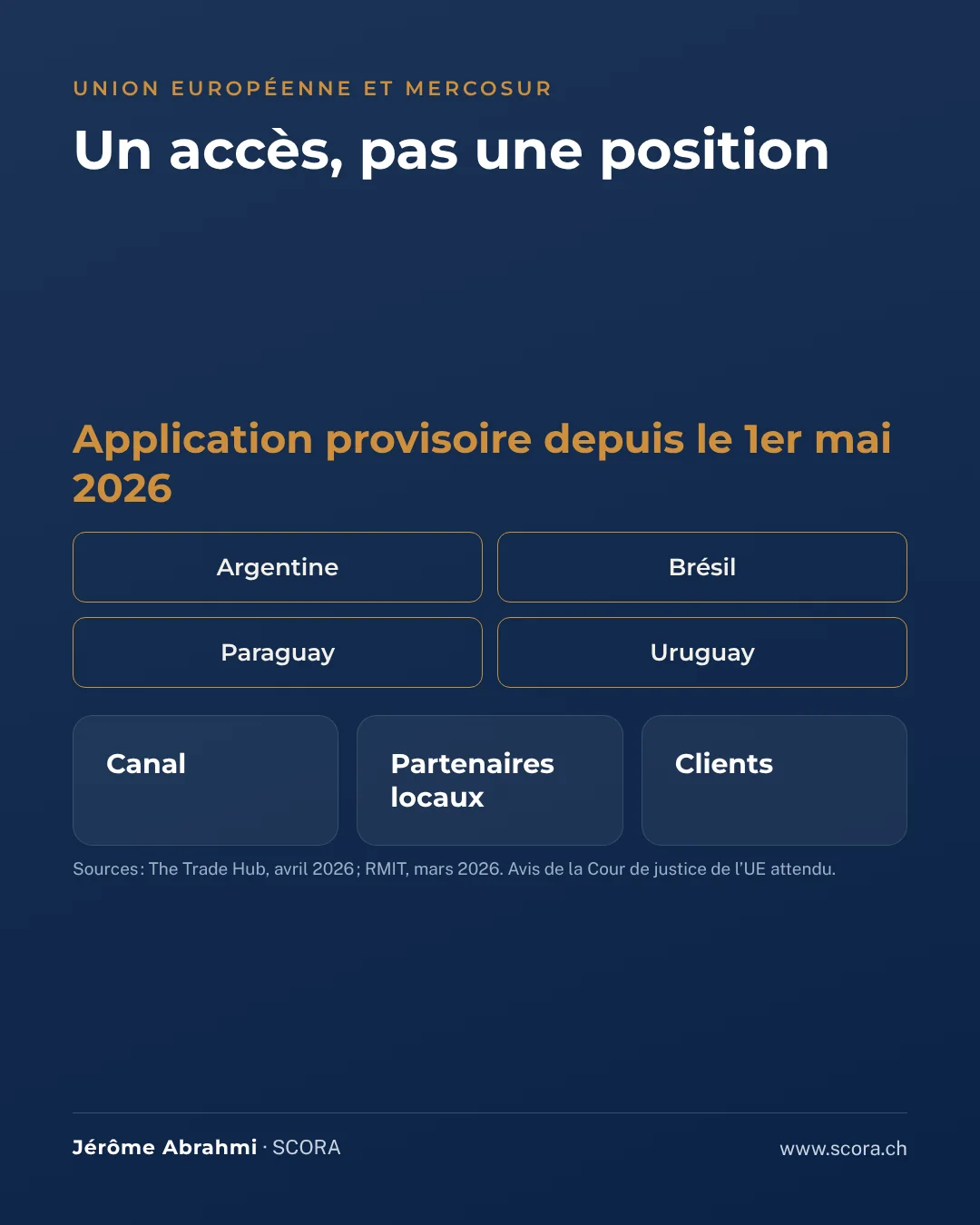
The EU-Mercosur partnership agreement, together with an interim trade agreement covering its trade provisions, was signed on 17 January 2026. In the Council, 21 of the 27 member states had voted in favour. The interim trade agreement has applied provisionally since 1 May 2026 with Argentina, Brazil, Paraguay and Uruguay. Customs duties are reduced or removed depending on the product, with transition periods of up to eighteen years and quotas for certain sensitive agricultural products.
On 21 January 2026, the European Parliament requested an opinion from the Court of Justice of the European Union on the compatibility of the agreement with the Treaties, by 334 votes to 324 with 11 abstentions. The request concerns in particular the division of the agreement into two instruments and its rebalancing mechanism. It suspends the Parliament's consent procedure until the Court delivers its opinion. Should the Court find the agreement incompatible, it could not enter into force without amendment. An opinion procedure generally takes more than a year.
In parallel, Poland brought an action against the Council and requested the suspension of the agreement's application. On 29 September 2026, the Court dismissed this application for interim measures (Case C-460/26 R), as no serious and imminent harm had been demonstrated. At that date, final ratification had not taken place.
Scope of the agreement for a European manufacturer
The agreement opens access. It does not, by itself, create a commercial position. Tariff reductions are phased in over time and benefit every European exporter of the same product. A competitor that already has a channel, local partners and a sound knowledge of customers will take advantage of them more quickly.
Position depends on three choices. The first is the channel: direct sales, a distributor, an agent or a local partner do not involve the same cost of service or the same sharing of margin. The second is partners: in markets where relationships and language matter as much as price, the choice of a distributor or partner commits the company for several years. The third is knowledge of customers: these markets cannot be read from Paris or Geneva, and culture and negotiating practice weigh as much as the customs tariff.
Legal uncertainty leads to the same conclusion. A strategy based solely on the tariff advantage depends on the outcome of the pending proceedings. A position built on the channel, partners and knowledge of customers retains its value, whatever the ratification timetable.
Conclusion
The EU-Mercosur agreement reduces customs duties, but it does not determine which companies will benefit from it. They will be those that have chosen their channel, their partners and their customers before the tariff advantage is fully in place, and whose position does not depend on the outcome of the pending legal proceedings.
Sources
- White & Case, 10 March 2026: signature, interim trade agreement, effects of the request for an opinion, transition periods.
- Real Instituto Elcano: European Parliament vote of 21 January 2026 and subject of the request for an opinion.
- Notes from Poland, 29 September 2026: provisional application, Council vote, order in Case C-460/26 R.